EclectEcon

Economics and the mid-life crisis have much in common: Both dwell on foregone opportunities

C'est la vie; c'est la guerre; c'est la pomme de terre . . . . . . . . . . . . . email: jpalmer at uwo dot ca


. . . . . . . . . . .Richard Posner should be awarded the next Nobel Prize in Economics . . . . . . . . . . . .

Saturday, December 31, 2005

Nobel-Prize Winning Research Rejected

Thanks to BenS, here is a link to a paper that chronicles all the research that was rejected by journals but which later, when published elsewhere, led to Nobel Prizes for the scholars.

Sadly, the author seems to see this as some deviation from the ideal.
[M]ost of [the] instances discussed above deal with genuine resistance to scientific discovery and it is illuminating to ascertain some of the reasons why such a resistance exists in the first place.

A possible explanation that could motivate peer resistance to scientific discovery lies in the fact that new theories or discoveries often clash with the orthodox viewpoints held by the referees.

... In other instances the problem is that referees did not appreciated the potential or the interest of the new discoveries. ... Something is wrong with the peer review system when an expert consider[s] that a manuscript is not of enough interest to be published and later the work reported in such rejected paper earn[s] the Nobel Prize to their authors.
A more positive interpretation is to see these errors of commission and of omission as part of a normal, evolutionary process.

I see them as something to be expected, given scarcity. More importantly, I see the results as evidence that the system works! It is a ringing endorsement of competition among academic journals: if one journal rejects a brilliant, path-breaking article, another has an incentive to publish and move up in the citation rankings. Without that competition, some of the break-throughs might never be published.
For what it is worth, I noticed that the author had no instances of early journal rejection of Nobel-Prize winning work in economics.

Thursday, December 29, 2005

The Three-Inch Conspiracy, Inflation, and Money Illusion

What is the average difference between the true height of a basketball player and the height listed in the programme?

I had friends 40 years ago who used to laugh about being listed at 6'2" when they were really only 5'10" or maybe 5'11" with shoes on. This deception has been going on for decades; everyone knows it and everyone adjusts.

Here is more, buried in the comments section of this posting about Yao Ming. [h/t to Tyler Cowen's piece on Yao Ming for leading me there]. The consensus there seems to be that the average amount of over-statement of basketball players' heights is about 3".

Is the Three-Inch Conspiracy like simple inflation? Not quite, since inflation is usually represented as a rate of increase, not a specific amount of an increase. For the conspiracy to be be like inflation, it would have to be a 5% conspiracy or something like that.

Is the Three-Inch Conspiracy like money illusion? In some ways it is. While "everyone knows" the heights of basketball players are over-stated in the programmes, no one knows for sure how much each player's height is over-stated. And some people rely on official height data, even though the data are inaccurate. That seems a bit like money illusion to me.

Mutual Funds and MERs

Recently, I attended a social gathering where there were several fund managers for a firm that sells mutual funds. I commented with some question about the high management expense ratios [MERs] for their product and expressed a preference for passive, index-based funds with very low MERs (as I recall, this was after one of my acting gigs, and they knew me as an actor, not as an economist).

Their response was,

What does the "M" in MER stand for?
Management! We manage the fund so it does better.
I don't believe them. On average, especially in well-developed markets like the US markets, index funds tend to outperform managed funds, especially once all the fees are taken into account.

Now there is a calculator/analyzer available to help assess the fees and expenses involved with mutual funds. According to the Washington Post [reg. req'd]:
The online tool now contains up-to-date fee and expense information on practically all of the more than 18,000 mutual funds and 160 Exchange Traded Funds (ETFs)...

More than 50 million American households have money in mutual funds. What NASD has done is to go beyond just telling investors they need to scrutinize fees and expenses before investing in mutual funds. The regulator has provided a much-needed tool to help people put that advice to action.
Although Jeff Cosford has sent me some evidence that counters the theory, I still, in my blissful and rational ignorance, subscribe fairly strongly to the Efficient Markets Hypothesis.

Wednesday, December 28, 2005

France: The Ted Bundy of European Nations

From Vile France, by Dennis Boyles (h/t to BenS) [I quoted the first part of this material earlier] :
In very large numbers, the French don’t like us…What we mistakenly see as a craven, anti-Semitic, insecure, hypocritical, hysterically anti-American, selfish, overtaxed, culturally exhausted country, berefit of ideas, fearful of its own capitualation to Islam, headed for a democraphic cul de sac, corrupted by lame ideologies, clinging to unsupportable entitlements, crippled by a spirit-stomping social elite and up to its neck in a cheesy soufflé of multilayered bureaucracy is actually worse than all that. It’s vile.

… In just the last half-century or so, France has been guilty of eagerly abetting the Holocaust; perpetrating more postwar anti-Semitic acts than any other country in Europe; enabling and supporting state-sponsored genocide and slaughter in Africa and Asia; attacking unarmed civilians on foreign territory; arming enemies of Western democracies; treating its young with disain and its elderly with a neglect that is often fatal; suppressing conventional human rights, especially the right to free speech; protecting murderers and war criminals from justice; pursuing a foreign policy in which mendacity is a strategy used against both friends and enemies; polluting the earth while rhetorically demanding planetary hygiene from others; pursing illegal trade activities; engaging in massive, systematic corruption and greed; worshiping self-seriousness; and undermining American foreign policy wherever possible, no matter how many lives that costs. France looks great and seems swell but it acts hideously. It’s the Ted Bundy of European nations. (Denis Boyles, Encounter Books, 2005, p.5).

I don't know whether the London Public Library has ordered the book, yet [here is my earlier post on the subject].

Co-mingled Recycling at UWO

Several (many?) years ago, The University of Western Ontario embarked on a massive recycling programme. There were
  • Blue boxes for fine paper only
  • Blue swing-top cans for glass bottles
  • Blue swing-top cans for aluminum cans
  • Blue swing-top cans for plastic bottles
  • Blue swing-top cans for newspapers, and
  • White cans for other waste

That is a lot of receptacles! The hallways in some places seemed completely lined with recycling containers for different types of waste.

Something has changed. Maybe people at the university were not sorting properly, thus making the recycling more expensive (are literacy levels of incoming students deteriorating that badly?); or perhaps the sorting was not very beneficial relative to its costs. At any rate, most of the blue cans now have big, supremely and pretentiously redundant labels:

Co-mingled
Beverage Containers
Glass, Plastic, Tin

Co-mingled? C0-mingled???

Why didn't they omit that unnecessary word and use "aluminum" instead of "tin"?

When is the last time you saw a tin beverage container, even a tin-coated one?

And when was the last time you used the self-redundancy, "co-mingled"?

Here is a piece I wrote about recycling many years ago.

Tuesday, December 27, 2005

How Much of a Worry is Global Warming?

Not much, if you accept the research reported by Joseph Bast in a report put out by The Heartland Institute. (also see Taken by Storm).


Here is a summary of just a few of the points made by Bast in his commentary on Michael Crichton's State of Fear:
... [T]he message of State of Fear has serious public policy consequences:

Most of the environment and health protection regulations in the U.S. ought to be reformed so they address real rather than imaginary risks, and concentrate on what works instead of the liberal orthodoxy of big government solutions to every problem.

The U.S. is quite right to stay out of the Kyoto Protocol--the global warming treaty--and ought to be doing more to persuade other countries of the world that the protocol is unnecessary, premature, and unworkable.
For more on global warming, in addition to the books shown below, I recommend this recent post at Cafe Hayek and this one by the ever-vigilant group at London Fog.


Monday, December 26, 2005

Self-Serve Check-outs

I had never seen or heard of "self-serve" check-outs until I visited my son in Houston a couple of years ago. To use one, you scan your own merchandise, scan your credit or debit card, bag your own groceries, and away you go.

My first reaction was, "Geez, I wonder what the inventory shrinkage (shop-lifting) is with this system."

Don Boudreaux of Cafe Hayek wondered the same thing. He attributes their success to trust and honesty.
The fact that the number of self-checkout lanes is increasing tells me that these lanes are proving to be successful — proving to be worth their costs. In turn, this fact tells me that the people who shop in these stores are generally honest. The number of cheaters, although surely positive, is not great enough to make the provision of self-checkout lanes a losing proposition for retailers.

Phil Miller has additional intriguing insight: Employee theft is generally a much more serious problem than shop-lifting.

While I was working on my Master's degree, I worked as an assistant manager for a well-known pharmacy chain and in terms of theft prevention, our number one focus was employee theft, not customer theft. My fellow managers and I went to seminars where we watched surveillance camera films showing various employees stealing from their stores. We also heard stories about employee theft. The cameras that were installed to identify theft were installed over the cash registers.

Employee theft takes lots of forms. Employees can steal cash, merchandise, credit card numbers etc. They can also help their friends steal stuff by placing unscanned merchandise into bags with paid-for merchandise.

By substituting capital for labor at the checkout stands, retail stores can help combat employee theft. With the self-service stations, I'd argue that since there are fewer employees handling transactions, many stores are actually preventing theft from occuring.
At least two questions linger for me:
  1. How do the stores deal with merchandise that has the electronic theft protection embedded when it goes through the self-serve checkout?
  2. We don't have them in Canada, yet. Why not? Is the relative price of labour (compared to capital) lower in Canada than in the U.S.? If so, not much. Or is Canadian retailing irrationally and inefficiently behind the times?

Sunday, December 25, 2005

A Terrific Gadget,
bordering on being a necessity

Last week, I bought one of these: an iRiver AFT-100 FM transmitter.
I use it to listen to podcasts through my car's sound system from my MP3 player while commuting to and from the university. It works really well, is easy to figure out, and has considerable flexibility (including three different, user-selectable, FM pre-sets, which come in handy if you have several different places on the dial that are clear at different parts of a long commute). Playing back music or interviews from an MP3 player through the car's stereo system works much better than driving with headphones (and is safer, too)!

I know there are many different devices on the market that do the same thing, but this one does the job really well for me.

Spider Stalemate

Some time ago, I posted a question about what happens in Spider solitaire when you run out of cards in the piles across the top, and the game won't let you deal any new cards because each column or slot must have at least one card in it. Some of the commenters did not understand what I was asking, but Chris (one of my brighter intro students) did. Furthermore, he sent me this graphic to show that, indeed, the game does essentially lock up or stalemate:


Those of you who are familiar with the game will see that in this play, Chris used the single-suit version and played nearly all of the cards from the piles across the top, leaving him with only nine cards plus an empty slot. The box in the middle says, "You are not allowed to deal a new row while there are any empty slots." But he doesn't have enough cards left in the piles to fill all the slots.

I'd call that a stalemate, not a loss.

Thanks, Chris!

Saturday, December 24, 2005

Stroke Recognition: More Information Beyond the 3 Basic Questions

Last March, I wrote about stroke recognition. We have printed this information and posted it on our fridge:

The warning signs of a stroke are:
  • Sudden numbness or weakness of the face, arm, or leg, especially on one side of the body.
  • Sudden confusion, trouble speaking, or understanding.
  • Sudden trouble seeing in one or both eyes.
  • Sudden trouble walking, dizziness, loss of balance or coordination.
  • Sudden, severe headache with no known cause.

The three easy questions are:
  1. ask the individual to smile.
  2. ask him or her to raise both arms.
  3. ask the person to speak a simple sentence.
If s/he has trouble with any of these tasks, call 911 immediately, and describe the symptoms to the dispatcher.

But there is much more that is worth knowing. From Jack:
There is an additional bit of information to be aware of: the possibility of reversing the impact of a stroke if one gets proper medical treatment within three hours of symptom onset. This applies to the majority of strokes which are caused by blockages in blood supply to part of the brain. It does not apply to those caused by bleeding into the brain. The steps required for possible stroke 'reversal' are:

1/ Get to a major hospital emergency department as soon as possible, and certainly within three hours of symptom onset.

2/ Bring up the possibility of administering clot-busting drugs to the emergency MD immediately; if he/she is on the ball and facilities permit, an emergency CT scan should follow very quickly. The CT is necessary to detemine if the stroke is caused by a blockage /clot (good) or a bleed (bad). If it is the former, then you should receive a clot busting drug intravenously. All of this ideally transpires within a three hour time frame of symptom onset.

Don't assume this will automatically happen. [There are instances when it hasn't.]

This link is an older statement for the public, but still applies.

And this link gives a broader context to treatment.

Friday, December 23, 2005

Christmas-nomics

Two totally unrelated items about economics and Christmas:
  1. Daniel Gross writes in Slate that Christmas tree sales are a good concurrent indicator of consumer spending during Christmas.
  2. Christmas lights and timers. With the invention of the little LED Christmas lights that use very little electricity, it probably makes no sense to buy a $30 outdoor timer that will turn the lights off during the day. I haven't done the calculations, but I can readily imagine that leaving even 120 of these lights on for 24 hours a day for a month adds no more than a few dollars to the electricity bill. So why bother with a timer? In fact, if the prices represent the opportunity costs of using the scarce resources in various ways, it would downright anti-social and inefficient to buy a timer for these lights.
Update: There's more here, at the new site for this blog.

How to Attract a Mate

This advice is for males.

I recently listened to the podcast interview of Donald Cox by Russell Roberts. Near the end of the podcast, they agreed there are only three ways for men to show they have the financial wherewhithal to sire large, healthy clans:
  1. Laminate your income tax return and flash it around. Failing that,
  2. Buy an expensive car or
  3. Buy an expensive watch [reg. req'd, h/t to BenS for the link].
While the list is amusing ($1.5m for a watch!!??), I can think of several other possibilities.
  • Buy expensive gifts for prospective partners.
  • Make huge donations to specific charities (Bill G appears to have learned this well).
  • Wear expensively tailored clothes.
  • Alternatively, wear a military officer's uniform.
  • Order only the best wines.
  • Snub the PLO.
I'm sure there many more. Feel free to add to the list.

Since I would lose any of these competitions, I'm delighted to live in a monogamous culture.

Thursday, December 22, 2005

Might Israel Try to Destroy Iran's Nuclear Weapon Capability?

With the recent hostile speeches by Iranian President Mahmoud Ahmadinejad, Israel must take a very cautious stance. On the one hand, he sounds like someone who might very gladly use nuclear weapons against Israel just to get rid of the Jews, in which case a pre-emptive strike is called for. On the other hand, he might be attempting to provoke an attack by Israel, with the hope of cementing other Muslim support against Israel.

Stratfor has an interesting take on how Israel might attack Iran, should they decide to do so. [subscription req'd; h/t to JP]
Iranian President Mahmoud Ahmadinejad's latest inflammatory statements, in which he called the Holocaust a "myth" and suggested that Israel's Jews be relocated to Europe or even Alaska, are part of a series of provocations that have severely escalated political tensions between Iran and Israel. Furthermore, Israeli military officials have said that Iran is within months of being able to produce nuclear weapons. Because of its extreme vulnerability to a nuclear attack, Israel's threshold for using the military option to prevent Iran from acquiring nuclear capability is lower than the United States'. Should Israel decide to attack Iran's nuclear facilities, the operation would be risky, difficult and politically delicate -- but not impossible.
The major problem would be forming the political alliances that would free up some air space for the IDF to fly through.

Then again, consider this by C. Hart of WorldNewsDaily:
Most media attention has focused on when Iran might have nuclear capability and if Israel should act against Iran independently. Little attention has been paid to the possibility of an Iranian pre-emptive strike against Israel, despite the fact that this remains a major concern of Israel's military advisers.

Worried About Avian Flu?
Don't Try to Stockpile Tamiflu via the Internet

It seems that many people are not only concerned about the possibility of an Avian Flu pandemic, but they are trying to prepare for it by stockpiling Tamiflu, despite repeated warnings (see here and here) that it may not be very effective in most instances.

But of course stockpiling Tamiflu through regular channels is difficult. The gubmnt has indicated it will commandeer much of the supply for whomever it deems most in need. And at current, gubmntly-induced artificially low prices, there is an excess quantity demanded. Not surprisingly, many people wishing to hedge against the possibility of an avian flu pandemic are turning to the internet to order and stockpile Tamiflu. Let's hope it has some placebo effect because much of the vaccine ordered over the internet turns out to be counterfeit, with possibly no more than vitamin C as its main ingredient [h/t to Jack for the link].
[A]gents have seized 51 separate packages, each containing up to 50 counterfeit capsules labeled generic Tamiflu.

The fake drugs had none of Tamiflu's active ingredients, and officials were running tests to determine what the capsules did contain. Initial tests indicated some vitamin C in the capsules, said David Elder, director of the Food and Drug Administration Office of Enforcement.

... Agents became suspicious because Tamiflu is produced by Swiss pharmaceutical manufacturer Roche, and there is no generic version available.
This is to be expected. When the gubmnt sets a price ceiling, black and grey markets develop, and it is much more difficult to assess quality and reliability, and to enforce contracts, in these markets.

Wednesday, December 21, 2005

How to Attract a Mate

This advice is for males.

I recently listened to the podcast interview of Donald Cox by Russell Roberts. Near the end of the podcast, they agreed there are only three ways for men to show they have the financial wherewhithal to sire large, healthy clans:
  1. Laminate your income tax return and flash it around. Failing that,
  2. Buy an expensive car or
  3. Buy an expensive watch [reg. req'd, h/t to BenS for the link].
While the list is amusing ($1.5m for a watch!!??), I can think of several other possibilities.
  • Buy expensive gifts for prospective partners.
  • Make huge donations to specific charities (Bill G appears to have learned this well).
  • Wear expensively tailored clothes.
  • Alternatively, wear a military officer's uniform.
  • Order only the best wines.
  • Snub the PLO.
I'm sure there many more. Feel free to add to the list.

Since I would lose any of these competitions, I'm delighted to live in a monogamous culture.

Advice for IT Start-up Companies

Many people seem to have the notion that the way to get rich in the information technology industry is to start a company and then sell it to Yahoo, Microsoft, or Google. That kind of thinking is a clear example of the ex post, ergo propter hoc fallacy. Just because some entrepreneurs have made money by doing this, it does not follow that (a) this was their goal, or (b) setting out to build a company that you can sell is a good strategy. Generally speaking, the biggies won't want to buy your company unless it is successful and could make a lot of money on its own anyway.

Here is Paul Kedroski on this topic:

If you are building a startup solely with the intent of flipping it to one of the majors then you are playing Russian roulette using a gun with five full cylinders, and one cylinder containing a bullet that flits in and out with 50% probability. It is, in other words, a stupid game, one that ex post looks more rational than it would truly be to have done ex ante.

The best way to get purchased by anyone -- GYM included -- is to build a great team, find a large and growing underserved market, build a great product/service for which people will pay more than it costs to provide, grow faster than the market, and stay paranoid that a hundred other companies are gunning for you all the time. If that sounds a lot like the path to building a company, not merely one that is built to flip, it isn't just a coincidence.

Building companies to flip is a dumb exercise, one that more often than not produces neither a company nor flipping.

One possible exception to this strategy emerged in the comments (I recommend you read them all): If part of the plan for obtaining venture capital for a startup must include the possibility for a sell-off to GYM, then by all means it is worth thinking about and planning for that possibility.

Trade Restrictions and Disaster Relief

What is the best way to amplify the damaging effects of a natural disaster? From The Emirates Economist:
Use the strong arm of the government to prevent foreign suppliers from rushing in when domestic supplies are disrupted.

Who loses? The consumer.
Of course, if foreign suppliers rush in, domestic suppliers will scream about "carpet-baggers" and "foreigners" ripping them off and exploiting them. But these complaints will be smoke to disguise their attempts to protect their local market power.

It is sad, but politicians will tend to respond to the arguments of domestic suppliers, not consumers, and the effects of the disaster are made all that much worse as a result.

As an example, EmEc links to this item, which points out that hurricanes Katrina and Rita severely damaged the U.S. sugar crop, thus shifting its supply curve to the left and nearly doubling the price of sugar. Opening the borders to imported sugar could help reduce the size of this effect...

Monday, December 19, 2005

Gift Shopping on the Internet

. . . . . .Toys_120X90

Composite Drawlings Praises Bolton's Job at UN

Rebekah K. at Composite Drawlings also writes a weekly column for her local newspaper; fortunately, it is also available online for us all to read. In a recent piece, she praises the job John Bolton has been doing at the United Nations.
First, at the beginning of this month, Bolton told the UN — as they signed the Palestinian Resolutions which, among other things, condemn Israel for defending itself against terrorism and call for Israel to surrender even more land to the people who were trying to eliminate them — they were increasingly demonstrating their irrelevance.

... Following that scathing speech, he came out three days later (after another suicide bomber attacked and killed innocents in Israel) with a few choice words for the Security Council: "you have to speak up in response to these terrorist attacks. It's a great shame that the Security Council couldn't speak to this terrorist attack in Netanya, but if the Council won't speak, the United States will."

Bolton has been pressing the members of the United Nations to start cleaning up their acts, has demanded that those who sit on the Human Rights Commission have at least made an effort to protect basic human rights (no more China, shooting civilians for sitting in protest against local land-grabbing governments, no more Zimbabwe and its bulldozing homes of the poor, no more Cuba and imprisoning good people for having the chutzpah to contract AIDS, no more Iran or North Korea or any other nation whose record on human rights is blatantly abysmal). He’s informed the UN that the corruption which seems to flow from the top down must be cleaned up, or else we will find — or build — a new treaty organization which is willing act both responsibly and effectively.

... Dang, it must gall the folks who wanted him filibustered into oblivion! He came in fast and low, under the radar, and slipped in by interim appointment, and now there’s nobody to stop him from wreaking havoc on the heretofore smug, slimy oysters at Turtle Bay.

The Best Christmas Present You Can Give a Young Person

Smash their calculator(s).

I am semi-serious.

Last week I had several first-year university students complain because I will not let them use calculators on exams, and they did not know how to calculate a present value problem which was basically the following:

NPV = 1210/(1 + .1) + 1210/(1 + .1)(1 + .1) - 2000

I know I seem like a curmudgeon, but this reaction from university students (who presumably had "A" averages in secondary school) is frightening and discouraging.

Sunday, December 18, 2005

Depreciation of the U.S. Dollar:
a question of "when", not "if"

The U.S. dollar has remained strong during the fourth quarter of 2005 despite continuing trade and U.S. federal gubmnt deficits. There are two related reasons for its continued strength:
  • Anticipated continued tightening by the Fed, albeit at a slower pace, has kept U.S. interest rates attractive for foreign (and U.S.) short-term financial capital.
  • Continued unease about international politics makes the U.S. economy seem less risky than many other options. As I asked last spring, "Where else would you put your money?" I realize there are many options, but just how risky and how attractive are they?
Ben Carliner pointed out last month that the strength of the U.S. dollar is not likely to persist:
Well, in the short term at least, America’s twin deficits just don’t seem to matter. The markets’ attention is elsewhere, and for much of the world, continued economic growth is predicated and strong US demand. Unfortunately, in the long run, current account deficits do matter, and putting off the day of reckoning will make the correction, when it does come, all the harder.
Boom!
Nouriel Roubini has a similar outlook:
In 2006 the structural medium term factor that will tend to weaken the dollar - the large and growing US current account deficit - will reassert its role while the short term cyclical factors that have lifted the dollar this year will tend to weaken their effect. So, at the end you cannot fight the laws of gravity as the cyclical forces that have defied such gravity are temporary while the forces that will cause a gravitational fall of the US dollar are as strong as ever.
Ooomph!
However, Brad Setzer suggests that maybe the rest of the world is willing to keep financing the U.S. twin deficits for quite some time:
Of course, the US can only spend more than it earns so long as the rest of the world is willing to finance the US.

And the People's Bank of China is certainly aware of that it will take large losses on its dollar portfolio if it continues to finance the US. Last I checked, Yu Yongding sits on the PBoC's monetary policy committee, and he was pretty clear about this in a recent speech.
... So far, though, Yu has not convinced the Chinese government to cut back on its reserve accumulation: Chinese reserve accumulation has grown every year since 2000. And so long as China, Russia and Saudi Arabia's central banks are as willing as the markets to finance the US - if not more willing - the US seems set to keep on spending.
So when will they stop, if ever?

For a set of invaluable links and references on the economics of foreign exchange rates, see this post at The New Economist.

Saturday, December 17, 2005

The Sound of Music:
Best Movie of All Time?

Many members of The Philistine Liberation Organization have argued persuasively that The Sound of Music was the best movie ever made. In fact, a discussion of this argument is scheduled for the next PLO Conference.

So you can imagine the delight of some PLO members as we learned that The Sound of Music was going to be televised this evening. Correspondents were Rondi Adamson, Alan Adamson (co-blogger at Curling), along with EclectEcon.

EclectEcon: The best movie ever made is on tv tonight on many different channels at 8pm.

Time to fire up the old microwave (to make some popcorn)!

Alan: A night for a major PLO party!

My TV Guide says 7pm. Would not want anyone missing what there is to be done with Maria!!

Rondi: It's on at 7! Yes, I've known about this all week and have been REALLY looking forward to it. Following the PLO theme, I thought I would have CheezWhiz and crackers, rather than something as classy as popcorn.

Alan: I have to confess, after my generally positive experience with King Kong, I am thinking of tuning in tonight.

Rondi: I'll be very happy to have converts of any kind, even if they're not whole-hearted! (Hey, you can blog about it!)

EclectEcon: This entire exchange is definitely blogable. Any objections?
confession time: I'll probably watch the NFL instead.

Alan: please blog - my guess I will be back and forth between the nfl and SoM

Rondi: None from me. You might want to mention I'll be partaking of some pretty classy Cotes du Rhone, as well. I'm not a *complete* rube! Mmm...cheez whiz and red wine...

(Al, you'll see, at the end, it doesn't indicate in any way, shape or form, that the von Trapps walked to Switzerland in 24 hours! That is, if you stay awake...)

Alan: I am sure I will be asleep at the point of their amazing trip from Salzburg to Switzerland. I am willing now to accept that the movie makes no commitments about how that magic heppened. Or how long it took.

EclectEcon: Well, I didn't mean I'd live-blog it! Rondi, you should do that.

But live-blogging is generally more successful if it is well-advertised, as in, "Hey folks, next Xday at 7pm I'll be live-blogging the Sound of Music."

Rondi: Nah, the Sound of Music is best enjoyed in a relaxed manner...

Alan: Man is it good!! Ollie [his cat?] and I are totally hooked now.

Rondi: It is awesome.

Jeffery Sachs: East Coast Elitist Interventionist Who Knows How to Solve the World's Problems

Professor Jeffrey Sachs, Columbia University, is a very smart man. He knows a lot and knows how to express himself better than I could ever hope to. I recently listened to the interview with Sachs on Radioeconomics.com. It was everything I expected.

The solutions to world poverty (and other problems) proposed by Sachs are vague. They sound great, in that they involve promoting investment (he explicitly mentions building roads) and holding project managers accountable.

You know what? That is pretty much the same stuff we were taught by east-coast liberal interventionists 40 years ago, when I was an undergraduate. They know best.

Here is an interesting example: Sachs seems to think malaria would be wiped out if people would just donate a buck or so to help buy mosquito netting for all the poor people in Africa. And just what does Sachs think would happen to this netting? I am willing to bet that after a year, less than a third would still be in use as mosquito netting.

My solution to world poverty? There clearly are no quick fixes, but here are some things that will help future generations:
  • Stop listening to planners and interventionists who, no matter how sincerely they care, will end up enriching themselves and, especially, society's rent-seekers.
  • Create secure property rights and legal entitlements. Exchange and growth cannot be fostered without these as part of the framework.
  • Promote free trade, both internally and externally.
Along these same lines, in a recent editorial in the NYTimes [reg req'd], Tim Harford (the Undercover Economist) points out that reducing internal barriers to trade would go a long way toward improving efficiency and promoting development in many countries.
Part of the problem, of course, is that landlocked African countries are linked to the outside world by long, decrepit roads and underdeveloped ports in neighboring countries. But determined growers can move bananas along even lousy roads. The real problem is elsewhere: three-quarters of delays are the result of red tape, not port handling or inland transport. These delays, caused by senseless bureaucracy, unnecessary forms and archaic inspection practices, can often be eliminated with a stroke of a pen by a country's chief executive. Even the more sophisticated reforms, like introducing electronic filing, or using software to guide sensible risk-based customs inspections, require only small outlays. What's more, such reforms increase the interception of smuggled goods and discourage corrupt customs officials.
And therein lies the difference between The Economic Way of Thinking and the Elitist Interventionist Way of Thinking: Sachs wants to build roads; Harford wants to cut red tape.

. . . .

Friday, December 16, 2005

TypePad's Woes

Something isn't working at TypePad. Here is what they have posted:
Blogs are up. However, we are displaying backup copies of weblogs from a few days ago, so some of your newest content may not be showing.
I am really curious: what kind of commercial service is it that doesn't maintain access to ghost backups, hourly backups, or at the very least, daily backups? Many of my favourite blogs are now showing only postings from a week ago or earlier.
So much for the "45 free days" ...

More Evidence that Sex Sells

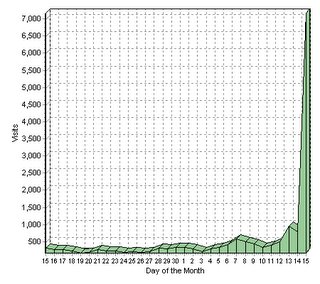
As if we needed any confirmation, look what happened to the hits on this blog after people started Googling and Yahooing and Whatevering "UWO student strip tease" and related topics, looking for the pictures and videos of the young woman at this university who performed for a roomful of young men:


To check the data over 30 days, click here. In his observation about a mid-day version of this graph, Phil Miller says,
Ever wonder why there are so many porn sites and why there are so few mostly-economics blogs? Me neither.
... It's a demand-side phenomenon!!!!
To tell the truth, I hadn't noticed ...

Residents' Choice: A threat to the President's Choice Brand?

In Canada, the Weston food group, Loblaw's, Zehr's and other grocery chains carry an in-store brand of many items called "President's Choice"; on average, this brand is higher quality than most store brands or most no-name varieties of the products.

Recently, an acquaintance who wishes to remain anonymous, has proposed that a group of us send the following letter to Loblaw's (Most of the names have been changed to preserve anonymity):

President
Loblaw’s

Dear Sir:

I am a member of a quartet of business men—an economist, a physician, a pharmacist and a sociologist who are planning a new product. We have been advised by the son of one of our members (who started law school in September) that there is a possibility our new product will infringe on your copyright, trademarks and patents. And we wish to reassure you on our new product and secure your permission to go ahead.

We plan on producing a new series of food products under the name RESIDENTS' CHOICE.

Our exclusive line of food products is targeted at the residents of nursing homes who have special eating needs not satisfied by other products such as your own President’s Choice foods. For example, your President’s Choice Caesar Sourdough Croutons are difficult (or shall we say hard) to eat because of their crispiness and are loaded with spice and acids (such as fumaric acid and citric acid) whereas our RESIDENTS' CHOICE Croutons will be unbaked pieces of Wonder Bread without the crust, or flavors added, much softer and less irritating on the gums of 90-year old residents.

Our line of RESIDENTS' CHOICE foods were developed by experts who are concerned with the health and vigor of nursing home patients in mind.

The market was studied by an expert with a great deal of experience with foods, the economist Dr. John Palmer, who is famed for his work with butter substitutes, and developed a theory of Margarine Utility.

Dr. Hippo Crates has had much experience with older patients and his own mother is 109 years old. He has been much reputed and has commendations and references from the captains of several seaworthy student boats, and has had very few student deaths, or pregnancies of the girls whom he had close contact with under his ship patronage licence.

Our pharmacist, James Jones, will be testing each of our RESIDENTS' CHOICE foods with mortar and pestle analysis of stress tolerance, permeability, and component correlation analysis. His analysis of digoxin digestibility following ingestion of peanut butter is well-known as the Jones Jive analysis and can be found in a recent issue of the Drug Store Gazette.

Finally, as the sociologist looking at group dynamics and eating in inbound collectivities, Dr. Peter Headcase shall be in charge of compatibility analysis and relationships among the different RESIDENTS’ CHOICE FOODS. He is well known for his study of Feedback and Foodback. (You may recall the recent case of another new product company which attempted to secure permission from the Law Counsel of Coca-Cola for his Kiet Doke which sounds a lot like Diet Coke).

We shall look forward to your reaction to our plans and your blessings.

Sincerely,

Thursday, December 15, 2005

Dietary Advice for Christmas

These ten commandments were sent to me by Jack, a physician, so they must be correct:
The Christmas Ten Commandments

1. Avoid carrot sticks. Anyone who puts carrots on a holiday buffet table knows nothing of the Christmas spirit. In fact, if you see carrots, leave immediately. Go next door, where they're serving rum balls.

2. Drink as much eggnog as you can. And quickly. Like fine single-malt scotch, it's rare. In fact, it's even rarer than single-malt scotch. You can't find it any other time of year but now. So drink up! Who cares that it has 10,000 calories in every sip? It's not as if you're going to turn into an eggnog-aholic or something. It's a treat. Enjoy it. Have one for me. Have two. It's later than you think. It's Christmas!

3. If something comes with gravy, use it. That's the whole point of gravy. Gravy does not stand alone. Pour it on. Make a volcano out of your mashed potatoes. Fill it with gravy. Eat the volcano. Repeat.

4. As for mashed potatoes, always ask if they're made with skim milk or whole milk. If it's skim, pass. Why bother? It's like buying a sports car with an automatic transmission.

5. Do not have a snack before going to a party in an effort to control your eating. The whole point of going to a Christmas party is to eat other people's food for free. Lots of it. Hello?

6. Under no circumstances should you exercise between now and New Year's. You can do that in January when you have nothing else to do. This is the time for long naps, which you'll need after circling the buffet table while carrying a 10-pound plate of food and that vat of eggnog.

7. If you come across something really good at a buffet table, like frosted Christmas cookies in the shape and size of Santa, position yourself near them and don't budge. Have as many as you can before becoming the center of attention. They're like a beautiful pair of shoes. If you leave them behind, you're never going to see them again.

8. Same for pies. Apple. Pumpkin. Mincemeat. Have a slice of each. Or, if you don't like mincemeat, have two apples and one pumpkin. Always have three. When else do you get to have more than one dessert? Labour Day?

9. Did someone mention fruitcake? Granted, it's loaded with the mandatory celebratory calories, but avoid it at all cost. I mean, have some standards.

10. One final tip: If you don't feel terrible when you leave the party or get up from the table, you haven't been paying attention. Reread tips; start over, but hurry, January is just around the corner.

Remember this motto to live by: "Life should NOT be a journey to the grave with the intention of arriving safely in an attractive and well preserved body, but rather to skid in sideways, chocolate in one hand, Orange Woody's in the other, body thoroughly used up, totally worn out and screaming "WOO HOO what a ride!"

Curious about Drug Interactions?
Check Out This Site

My favourite drug dealer, JB, has pointed me to this site, where one can check the interaction effects of various drugs. He cautions, though, that one must use internet information judiciously.

Yet Another Reason Not to Support the UN:
Map Obliterates Israel

The United Nations held a "Day of Solidarity with the Palestinian People" last week. A large map of “Palestine,” with Israel literally wiped off the map, featured prominently in the festivities.

Here is the full article that appeared last week.
Here is the map:


For more about why I seem so strongly pro-Israel, see what Mark Steyn has written [h/t to Jack]. Here is an excerpt:
So let's see: We have a Holocaust denier who wants to relocate an entire nation to another continent, and he happens to be head of the world's newest nuclear state.

(They're not 100 percent fully-fledged operational, but happily for them they can drag out the pseudo-negotiations with the European Union until they are. And Washington certainly won't do anything, because after all if we're not 100 percent certain they've got WMD -- which we won't be until there's a big smoking crater live on CNN one afternoon -- it would be just another Bushitlerburton lie to get us into another war for oil, right?)

So how does the United States react? Well, White House spokesman Scott McClellan said that the comments of Ahmadinejad "further underscore our concerns about the regime."

Really? But wait, the world's superpower wasn't done yet. The State Department moved to a two-adjective alert and described Ahmadinejad's remarks as "appalling" and "reprehensible." "They certainly don't inspire hope among any of us in the international community that the government of Iran is prepared to engage as a responsible member of that community," said spokesman Adam Ereli.

You don't say. Ahmadinejad was speaking in the holy city of Mecca, head office of the "religion of peace," during a meeting of the Organization of the Islamic Conference. There were fiftysomething other heads of government in town. How many do you think took their Iranian colleague to task?

Well, what's new? But, that being so, it would be heartening if the rest of the world could muster a serious response to the guy. How one pines for a plain-spoken tell-it-like-it-is fellow like, say, former U.N. Secretary-General Boutros Boutros-Ghali? As he memorably said of Iran, "It's a totalitarian regime." Oh, no, wait. He said that about the United States. On Iran, he's as impeccably circumspect and discreet as the State Department.

Wednesday, December 14, 2005

Toronto Not Prepared for Pandemic;
and quarantine won't work

If a Pandemic, such as Avian Flu, were to hit Toronto, the city's health professionals would not be able to deal with it very well, according to David McKeown, the city's medical officer of health [from National Post; Date: Nov 25, 2005; Section: Toronto; Page: 15 ($, no link available), h/t to Jack]:
A severe pandemic could render as many as 914,000 people sick, hospitalize 14,000 individuals and cause 4,300 deaths, according to Toronto Public Health.

If faced with this worst-case scenario, hospitals may be forced to reject some patients, either those suffering from the flu or those with other ailments. “In any emergency, whether it is a plane crash that sends a bunch of people to the emergency room or a city-wide pandemic, the health care system will set priorities and triage to make sure the most urgent health needs are attended to,” Dr. McKeown said.

An extreme outbreak would overwhelm not only hospitals, but also morgues. The city could be forced to store dead bodies in refrigerated trailers, said Barbara Yaffe, director of communicable disease control.

A second public health report released yesterday suggested quarantine measures cut disease transmission rates by about 50% during the SARS outbreak in 2003. However, because the incubation time for influenza is far shorter than for SARS, officials do not think quarantine would control a flu pandemic.

“Influenza is also very highly infectious and will likely be transmitted widely in the community before contacts could be identified and placed in quarantines,” Dr. Yaffe said.

The doctor added it is unclear whether wearing surgical masks would protect the public during an outbreak, saying that further study is needed. “There is currently no evidence available that the use of masks in public settings will be protective when the influenza virus is circulating widely,” Dr. Yaffe said. “However, we do know that individuals that wear a surgical mask properly at the time of exposure may benefit from the barrier provided.”
Jack's assessment:
Acknowledgement that short incubation period for H5N1 would likely render quarantine efforts ineffective and also that the emerging plan seems to be steering towards protection of 'key' personnel rather than saturating early invasion zones, as the WHO plan outlines. Inability of hospital system to handle even current load is admitted. Mormonize, I say. Those old nuclear bunkers of the 50's are going up in value ....

The Expected Marginal Benefits of Drinking:
in moderation, can it help keep you slim?

Can drinking help keep you slim? From the Daily Mail (h/t to BenS):
People who drink moderately every day are significantly less likely to become obese in later life than teetotallers, researchers found.

However, the image of the potbellied ten-pint-a-night man still holds true - those who indulge in binge or heavy drinking are 46 per cent more likely to become obese than those who don't touch a drop.
So, it is drinking in moderation (not to excess) that might be associated with a lower probability of obesity. And it is far from clear that there is a direct causal link.

If there is a causal link between drinking and weight control, though, it appears that the expected marginal benefit is positive for the first drink or so, but then turns negative.

In my own case, I know that the causal relationship does not work this way. Once I have even one drink, my inhibitions are greatly impaired, and I start eating any junk food I can get my hands on. But if there is nothing of interest in the house, I'm happy to run to the variety store (a half block away) in my bathrobe and slippers for some junk food.

Even in the winter.

Tuesday, December 13, 2005

UWO Student Stripper

There have been many visits to this blog lately from people using Google and other search engines to try to find the video of a UWO student who performed a strip tease for some guys who lived in her residence hall.

I do not have the photos or the video.

You can probably find them by following some links at this site.
You might also find some of the discussion there of interest.

And for those who want to know, yes, I saw a few of the photos;
and, no, I do not recognize the student.
For those who would like to read more, here is some news coverage of the incident.

DARK MATTERS:
Obscured thinking and shadowed language

This conference is not quite so racy as the one held by the same group last year, but it looks just as interesting. Unfortunately, they do not have a web page, so here is their call for papers:
April 6-8, 2006
University of Western Ontario
London, Ontario

DARK MATTERS:
Obscured thinking and shadowed language

This interdisciplinary conference seeks to explore the notion of "darkness" in its various conceptualizations and codifications, both throughout history and in the present. We emphasize the idea of the dark as a terrain of constant negotiation, and as a concept with a plurality of meanings and implications. The conference seeks to elaborate upon these diverse perceptions of darkness, from the idea of the abyss in philosophy or astronomy to darkness in photography and other visual arts, from theology and psychoanalysis to literary metaphors and tropes, and other potential ways of constructing, thinking about, or representing darkness in the present.

Suggested Themes:

dark humour…underworlds & afterlives…the void…a little Night-music…St John of the Cross…

mestizaje… minority languages …metaphors of blindness…Lacan…chiaroscuro & the Baroque…behind the veil…camera obscura …Freud…film noir …rhetoric of the absolute…black holes … nihilism and nothingness...the dark side of language: euphemism & taboo …

the death drive & the unconscious…Prince of Darkness: political justice & ethics…the abyss …things that go bump in the night…Nietzsche…the shadow play…not-white magic …

a flash in the darkness: phenomenology & post-structuralism…Heart & Liver of Darkness…

the visible invisible…Jung…negative theology…forgetting…Deleuze …black box…creation/destruction…the vanishing point…Calderón’s prison…“ít was a dark and stormy night"


We invite proposals for 20-minute papers on literature, linguistics, literary theory, philosophy, theology, visual arts, music, cinema, science, etc.

Proposals in English, Spanish or French (250-500 words) should be accompanied by a short CV and address, and submitted by January 9, 2006.

Please send submissions to:

Graduate Student Conference
Department of Modern Languages and Literatures
Room 115, University College
University of Western Ontario
London, Ontario, Canada N6A 3K7
Tel: (519) 661-3196 – Fax: (519) 661-4093
Or e-mail to: Monica Rettig (mrettig@uwo.ca ) or Meredith Snyder (msnyder6@uwo.ca)
I'm going to submit 20 minutes worth of economics jokes. I expect these folks would view that as a great example of dark humour. Now that I think about it, these folks might view anything I write as an example of "Dark Matter."

Smorgasbords, Marginal Utility, Information, and Expectations

From Wikipedia:
Smorgasbord is an anglification of the Swedish word Smörgåsbord. It is a buffet style table in a restaurant, or a holiday feast at home, prepared with many small dishes. For a fixed amount of money, you are allowed to eat as many of these as you wish.
Phil Miller has a link to an interesting variation on Smorgasbords — all you can drink for a fixed price:
About 200 undergraduates from the London School of Economics rampaged after an end-of-year fancy dress party, where they paid a flat £5 entry fee to drink as much as they liked for free between 11 am and 2 pm.
First blush economic analysis predicts that people will consume food, beer, whatever is offered at such an affair, up to the point at which the marginal utility is zero. And this analysis is correct so far as it goes. That's what most of us teach our intro students in economics when introduction the concept of marginal utility.

But there are some additional, important considerations that rational maximizers will tend to make:
  • The more I consume of one beverage or type of food, the less utility I will get from a different beverage or food (assuming that marginal utility drops off dramatically as stomach capacity is approached). As a result,
  • It might be better to view the problem as a constrained optimization with stomach capacity, drunken stupidness, or alcohol poisoning as the constraint. Is it the constraint that causes the reduction in utility?
  • The previous two points are short-run. But in most instances, the pleasure from eating is contemporaneous with the eating, but the pain of over-eating comes later. Similarly, the pleasure of drinking in these situations comes with the drunkenness, while the agony of the after-effects comes later. Depending on the consumer's rate of time-preference, and depending on one's expectations and information, the point at which one reaches an expected utility maximum varies from person to person.
With these considerations in mind, one can make some empirical predictions and observations.
  1. Assume younger people have a higher rate of time preference, and/or
  2. Assume some younger people have less experience and less information, thereby forming incorrect expectations about the expected utility from these activities.
  3. That helps explain why we don't see drinking and eating binges in senior citizen communities.
In other words, we older folks quit earlier, in part, because when we look at the expected net present value of future utility, we have better information. Hence we know when to quit without the ensuing negative utility that results from over-indulging.

Well, most of the time we do....

Monday, December 12, 2005

Second Best Biz-Blog in Canada

It was disappointing that EclectEcon was not voted the best biz-blog in Canada, but given that I never thought of it as a biz-blog, I guess second best out of the many that were nominated is pretty okay. Thanks to everyone who voted for this blog.

Cutting the GST:
"Stupid, stupid, stupid, stupid"

Shortly after Stephen Harper's proposal to reduce the GST, I wrote,
Stephen Harper seems to be drifting increasingly away from sensible economic policies. This drift is both disappointing at best.

His latest pronouncement is to promise to lower the GST from 7% to 5%. For those of you outside Canada, the GST is the Goods and Services Tax, something like a national sales tax or value-added tax. Lowering it would not be a great economic policy.
Many readers, especially at the Western Standard, disagreed with my position (see the comments there).

My colleague, Jim Davies, obviously agrees with these views [In the interest of accuracy, I learned most of this material from him, so it is probably better to say that I agree with his views]. Here's is an excerpt of his comments made for the CBC [h/t to Worthwhile Canadian Initiative].
"Most serious work done by economists who specialize in public finance indicates that the GST is a more efficient tax source than the income tax," Davies told the Canadian Press. "If the income tax cut is designed properly, it can provide similar benefit to lower-income taxpayers."

"Stupid, stupid, stupid, stupid," he said.
The same CBC piece quotes Bill Robson at CDHowe as sharing these views:
"If you want tax cuts that are going to promote work, going to promote saving, help us invest more and raise living standards in the future, the GST is not the tax you would go after."

Robson said it would be better to cut personal income taxes.
If we want to reform the GST, let's get rid of the exemptions and broaden its base.

"The Big Lie"

I often pride myself on being rationally ignorant about many things: given what I already know, and given my priors and expectations, I'm often unwilling to look into matters when someone tells me something. What are the expected benefits of doing so? Usually they are much less than the expected costs, so I let it go.

Within this framework, it is easy to understand why "The Big Lie" works as a strategy for despotic control. The ruler's subjects are told some horrid lies. And the costs of checking them out are made very high (the threat of pain and torture does that). After awhile, the subjects hear the same big lies often enough that they find it easier to believe the lies than challenge them. It is frightening.

Now read this [h/t to JC].
Commonplace in Islamic media and intellectual circles are accusations that Jews concocted the Holocaust, they control the media, they are Nazis, they inject HIV into Muslim children, they drink the blood of Muslim children, and of course that they are taking over the world, according to the Anti-Defamation League and as displayed across the pages of prominent Islamic newspapers.

The result is that Islamic leaders and media are systematically indoctrinating their people to believe all the ills of the Muslim world are the fault of someone else.

When such audacious statements and beliefs are brought to the attention of those in the West, the tendency is to brush them aside as ridiculous but ultimately harmless. We often subscribe to the "let them believe what they want to believe" mentality.

This is a dangerous fallacy. History has shown time and again that such beliefs are not harmless.

We must recognize that when the "Big Lie" is left unchallenged - as it was in 1930s Germany - humanity pays a heavy toll.

Sunday, December 11, 2005

Avian Flu:
the impact on the chicken market

If Avian Flu continues to creep forward as a threat to human health, once it becomes a full-blown pandemic [see Tyler Cowen's latest posting on this topic], the ominivores among us will probably have to cut way back on the chicken we eat. The reason, though, will not be because of fear of transmission from the meat to humans. Rather, the reason will be that working with chickens will become increasingly risky.
Imagine being one of a team of 12 people who go into a chicken barn at midnight to catch 22,000 chickens in 4 hours so they can be shipped off to the processor. Chicken catchers are in constant contact with chickens. They get scratched, and despite wearing masks (which most do not do in our area), they breath a lot of pollutant material.
As the risk of contracting Avian Flu grows, people will be more reluctant to become chicken catchers. And those who do will insist on being compensated both for the increased risk and for the increased costs of wearing additional protection. These increased costs will greatly reduce the supply of chicken meat. They will also dramatically reduce the value of chicken production quota in jurisdictions like Ontario that practice supply management.

If I were a chicken farmer, I would be tempted to sell the farm and quota; I do not think the market has fully capitalized or adjusted to this risk.

Tim Harford Challenges Perfect Complementarity

The two socks of a pair are perfect complements, right?

Not if you buy two dozen pairs of identical socks.

See Dear Economist.

Law and Order

There is no single thing that has disturbed my sleep pattern more than the television series, "Law and Order". Once they started showing re-runs at 11pm (Eastern time) on A&E and then switched to showing the re-runs at 11pm on Bravo, I have had trouble getting to bed at a decent hour.

The series, and its offshoots, have been captivating. As one of my friends wrote to me a number of years ago, "oops, gotta stop writing. L&O is about to start."

I have noticed lately, though, that I am less interested in the show. It's not just that I'm losing interest in the re-runs; I don't like the new episodes so much either.

Rebekah, at Composite Drawlings, explains why the shows have gone off her list, and I expect these reasons go a long way toward explaining why I have lost interest, too. Be sure to read her entire piece, but here's a short excerpt:
These pitchmen who have been writing the series — all three of the shows for that matter — seem to think that it's okay to vilify an entire religious group, and, for that matter, the majority of the country. Teaching a child right from wrong obviously must come into conflict with teaching a child about truth and love and all that warm fuzzy moral relativistic stuff, right? Oh, and the fundamentalists who kill and maim are never Muslims or atheists or anybody else, are they (except in the case where they're victimized into some unsavory act)? No matter what the crime, it's always white-bread Christians at fault, as far as these guys are concerned.
That wasn't the case when Moriarity played the assistant DA.

Pennies, Coins, Dirhams, and Fils

I have long argued that Canada (and the U.S.) should stop minting pennies and stop using them (for example, see here and here). My argument has been
  • Pennies don't buy anything any more.
  • The transaction costs of using pennies are seriously non-negligible.
  • When transportation and other costs are included, minting pennies generates negative seigniorage.

Imagine if the smallest-valued coin had the purchasing power of only one-quarter of a U.S. penny. In such an economy, one can readily imagine that people would just stop using the coin. And that is pretty much what has happened in the United Arab Republic [h/t to the Emirates Economist]

Despite Central Bank of UAE figures saying that 1, 5, 10 fils coins are in mass circulation, residents and shopkeepers say they rarely see them.

“The Central Bank has not withdrawn from circulation any of these denominations and continues to issue them according to the needs of banks in the amounts they require on a weekly basis,” Rashed Al Fandi, UAE Central Bank’s executive director for banking operations, told Emirates Today.

“The large quantities of these denominations in circulation shows their availability in the market.” The Central Bank maintains that there is a demand for small fils coins and that the denominations are in circulation in significant quantities.

But if you buy vegetables and fruits in Dubai, you are likely to end up with a bill that totals 95, 48 or even 60 fils. Stores round off the bill, often in favour of the customers.

“We round it off to the nearest 50 fils or one dirham,” says Zorayda Esquerra of Carrefour, Bur Dubai. [1 Dh = 100 fils]

Plus de change .... The Canadian Mint says the same thing:
Banks want the pennies, so we mint them.
They take the orders from the chartered banks as a sign of demand, a sign that people actually want these small, useless coins. But that is just plain silly.

Look at the markets: people do not want these small coins. In Canada, people take and leave pennies in the penny cups at cash registers. In New Zealand and Australia, virtually everyone is happy to be rid of their one-cent and two-cent coins.

In the United Arab Emirates, people round to the nearest 50 Fils. And they do this not because the smaller coins are unavailable; they do it because they are a nuisance.

The solution is to declare legally that pennies (in North America) and small-denomination coins in the UAE are no longer legal tender but must be accepted for deposit by financial institutions.

Saturday, December 10, 2005

Women's Curling Finals on CBC
groan

The weekend draws of the Canadian Olympic Curling Trials are being shown on CBC. I must say, aside from the team of Adamson and Palmer, I really prefer the TSN broadcast team to any other curling broadcasters.

[aside: I've been told that Scott Russell was once a student of mine.]

For live-blogging of the event, see this blog.

Sudoku Math and Strategies

For those of you who are still addicted to Sudoku, here are explanations of two strategies for solving them (courtesy of CMT):

The X-Wing:
X-Wings are fairly easy to spot, but a little harder to understand than some other techniques. Like others it relies on using positions of pencilmarks to infer enough to allow you to eliminate some other candidates.

X-Wings are when there are two lines, each having the same two positions for a number.
The Swordfish:

This is very similar to using X-Wings, in that it will allow you to use knowledge about rows to remove candidates from columns, and vice versa. Make sure you're happy with why X-Wings work before moving on to Swordfish!

The complexity here is that you're using knowledge from 3 rows at the same time - and that's what makes them harder to spot. Unlike X-Wings, they don't form a simple rectangle.

If you're really intrigued by the mathematics (and a bit of history) behind Sudoku, check out this article [h/t to Tyler Cowen]:
From a computational point of view, Sudoku is a constraint-satisfaction problem. The constraints are the rules forbidding two cells in the same neighborhood to have the same value; a solution is an assignment of values to cells that satisfies all the constraints simultaneously.

Best Use Ever Made of a Citroen 2CV

Watch this video [thanks to Kent for the pointer].

I want to see them try this with a Hummer.

Friday, December 09, 2005

Best Biz Blog in Canada -- VOTE TODAY!!

EclectEcon made it through the first round of balloting and is still in the running! Please go to this site and vote for The Eclectic Econoclast (the former name of this blog).

Today is the last day to vote!

More Pessimism about Tamiflu & Avian Flu:
Theoretical Effectiveness vs. Use Effectiveness

I wrote a couple of days ago about the likely difficulty of using Tamiflu effectively to help fight Avian Flu. Here is more from my friend:
This distinction [between theoretical and use effectiveness] is often employed in discussion of contraceptive use, and should be applied to proposed H5N1 medications as well.

Just as condoms are far less effective in the bedroom (or stairwell) as they are in mathematical models, one might expect a similar discrepancy between ideal use of Tamiflu, and what is likely to happen in the community.

For usually non lethal Influenza A (your annual scourge) the importance of starting, for non immunized folks, antiviral medication within the first 48 hrs has been well publicized. Such a restriction has limited the effectiveness of antivirals. Recognition of illness, delay in getting to a physician - almost impossible in some settings within 48 hrs except through emergency or drop-in clinics - and a further delay in acquiring the medication, all conspire against effective early use.

Bird flu H5N1 promises to make effective use of available antiviral medication even tougher, given the shorter incubation period, and earlier arrival time of peak viral load. If we add to this dilemma the proposal of central control of medication and all the logistical snafus inevitably attached.........

Then we get to problems in applying the medication. How much, how long, and compliance given known side effects.

The optimistic among us will think of this as a challenge.

Thursday, December 08, 2005

Merck and Vioxx: The Market Works......
if we have good information

One of the reasons we have laws against fraud and misleading advertising is that if consumers cannot trust the information provided to them, they will devote too many scarce resources to divining and confirming information in the marketplace. This basic economic principle lies at the heart of the US civil suit against Merck and Vioxx [h/t to BenS]:
Authors of a study funded by Vioxx maker Merck & Co. failed to disclose in a report published in the New England Journal of Medicine in 2000 that three additional patients in a clinical study suffered heart attacks while using the now-withdrawn painkiller, the journal wrote in an editorial released Thursday.

The editorial, written by the journal's editor in chief, Dr. Jeffrey M. Drazen, executive editor Dr. Gregory D. Curfman and managing editor Stephen Morrissey, also alleges the study's authors deleted other relevant data before submitting their article for publication.

"Taken together, these inaccuracies and deletions call into question the integrity of the data on adverse cardiovascular events in this article," the doctors wrote. Excluding the three heart attacks "made certain calculations and conclusions in the article incorrect."

Are All Suicide Bombers So Young?
Are All Martyrs Young?

I have been struck by the age of suicide bombers; they all seem so comparatively young. I do not recall having seen any stories of 65-or-70-year-old suicide bombers (or martyrs to other causes, for that matter). I expect the comments will soon be replete with counter examples, but certainly in a general sense my observation is typical. Why is that?

It seems terribly wasteful for young people to give their lives for a cause, even if you agree with the cause. Surely it would be a much better use of a society's scarce resources if its suicide bombers, martyrs, and even some soldiers, were its senior citizens, who are more likely to be a drain on the economy in the near future if they aren't already.

My colleague, Ron Wintrobe, has a paper forthcoming in Public Choice and a book forthcoming from Cambridge University Press on the economic rationality of extremism. His argument, basically, is that suicide bombers rationally choose this role because they get immense utility from the sense of membership and belonging that comes with being a suicide bomber.

His work is compelling. And it helps explain why we do not see senior-citizen martyrs. It seems that a sense of belonging is much more important to young adults than it is to senior citizens.

But is that always the case? Have there been absolutely no cases of senior-citizen suicide bombers or martyrs for any cause? I find it difficult to believe, difficult to imagine, and difficult to accept that there isn't a sufficiently high variance of personalities that not even one senior citizen has been used as a suicide bomber.

Further, I find it implausible that are not at least some senior citizens who, expecting that their heirs would receive handsome bounties, would be willing to become suicide bombers. Is it just that the thought of 72 virgins in heaven means so little to old guys or is it something else? What am I missing?

Bribes from Aussie Wheat Board Funded Suicide Bombers

From The Australian:
KICKBACKS paid by Australia's monopoly wheat exporter to the regime of Saddam Hussein were put into a bank account used to finance a $US10million ($13 million) slush fund for families of Palestinian suicide bombers.

US Government and CIA documents reveal a trail of blood money flowing from companies now known to have taken bribes into bank accounts in Jordan, which were then used by the Iraqi Government to pay money for deadly bombings or to buy weapons.

According to a US inquiry into the corrupt UN oil-for-food program, companies such as Jordanian firm Alia, which received hundreds of millions of dollars from Australian wheat exporter AWB, paid money into "front" accounts held under false names.

These accounts were then emptied each evening into Iraqi Government accounts at the same bank and used for its international transactions.

... AWB, the former Australian Wheat Board, has been accused of paying $US222 million in illegal bribes to the Iraqi Government through the corrupt program. Its payments represented the biggest single contribution to an estimated $1.5 billion in kickbacks uncovered in an investigation by Paul Volcker.

... AWB admits making the payments to Alia but insists it thought the fees were for transporting wheat around Iraq and did not know it was a front company for Saddam's regime.

Wednesday, December 07, 2005

the Ant and the Grasshopper
(Canadian style)

BenS sent this story. I have seen it before in other renditions, but this one bears repeating. It is from the Nov. 28th edition of Chron Watch (h/t to JP, but I am unable to find the precise link):

CLASSIC VERSION:

The ant works hard in the withering heat all summer long, building his house and laying up supplies for the winter. The grasshopper thinks he's a fool, and laughs and dances and plays the summer away. Come winter, the ant is warm and well fed. The shivering grasshopper has no food or shelter, so he dies out in the cold.
THE END

THE CANADIAN VERSION:
The ant works hard in the withering heat all summer long, building his house and laying up supplies for the winter. The grasshopper thinks he's a fool, and laughs and dances and plays the summer away. Come winter, the ant is warm and well fed. So far, so good, eh? The shivering grasshopper calls a press conference and demands to know why the ant should be allowed to be warm and well fed while others less fortunate, like him, are cold and starving. The CBC shows up to provide live coverage of the shivering grasshopper, with cuts to a video of the ant in his comfortable warm home with a table laden with food. Canadians are stunned that in a country of such wealth, this poor grasshopper is allowed to suffer so while others have plenty.

The NDP, the CAW and the Coalition Against Poverty demonstrate in front of the ant's house. The CBC, interrupting an Inuit cultural festival special from Nunavut with breaking news, broadcasts them singing "We Shall Overcome." Sven Robinson rants in an interview with Pamela Wallin that the ant has gotten rich off the backs of grasshoppers, and calls for an immediate tax hike on the ant to make him pay his "fair share."

In response to polls, the Liberal Government drafts the Economic Equity and Grasshopper Anti-Discrimination Act, retroactive to the beginning of the summer. The ant's taxes are reassessed, and he is also fined for failing to hire grasshoppers as helpers. Without enough money to pay both the fine and his newly imposed retroactive taxes, his home is confiscated by the government.

The ant moves to the United States, and starts a successful agribiz company. The CBC later shows the now fat grasshopper finishing up the last of the ant's food, though spring is still months away, while the government house he is in, which just happens to be the ant's old house, crumbles around him because he hasn't bothered to maintain it.

Inadequate government funding is blamed, Roy Romanow is appointed to head a commission of inquiry that will cost $10,000,000. The grasshopper is soon dead of a drug overdose, the Toronto Star blames it on the obvious failure of government to address the root causes of despair arising from social inequity.
THE END

Is Homeopathy Just an Expensive Placebo?
or maybe an inexpensive placebo?

Quite possibly homeopathy is no more effective for many complaints than a placebo. From Lancet, courtesy of J:

Biases are present in placebo-controlled trials of both homoeopathy and conventional medicine. When account was taken for these biases in the analysis, there was weak evidence for a specific effect of homoeopathic remedies, but strong evidence for specific effects of conventional interventions. This finding is compatible with the notion that the clinical effects of homoeopathy are placebo effects.

I realize that traditional physician/practitioners have a strong incentive to find that homeopathy is no (or not much) more effective than a placebo, but suppose they're right.... Suppose homeopathy is just a different form of placebo.

If that is the case, which is more efficient? Expensive placebo-like drugs or homeopathy?

Reminds me of the time BenS and I were in a large, discount drug store, and he asked the pharmacist, very loudly, "Where is your selection of placebos?"

Tuesday, December 06, 2005

The Winter of Our Discontent?

Salim Mansur, writing in the Toronto Sun, waxes Shakespearean:
As the long federal campaign unfolds, it might well become Canada's political winter of discontent.

But at some point during this period it will be worthwhile if Canadians reflect on the price people have paid for democracy — and how it is not to be taken for granted.

... Securing freedom and imposing democracies on Germany and Japan after World War II ... required a coalition of willing allies united by their commitment to democracy, and Canadians of that generation carried their responsibility with pride and devotion of a free people.

Canadians, in their winter of discontent, will likely remain preoccupied with domestic quarrels and wishes, however insignificant these are in the larger context of a world where evil is perpetrated by men — as in Darfur — and peril looms as Iran seeks to acquire nuclear capability.

The story of Iraq is a reminder that some people somewhere paid the price for those in democracy to enjoy freedom to choose how they will live and who will govern them.
It's a valuable reminder.

Asian Flu:
How Effect Will Tamiflu Be? (not very)

Some people are hoping that tamiflu will help halt Asian Flu as/if it starts sweeping across the globe. Do not be optimistic. My friend who is a semi-retired physician has written:

As you know, the only dimly lit corner of the room for efficacy of Tamiflu to save lives in a pandemic comes from the mouse study. In that study, up to 80% of the infected mice survived, if given eight days of treatment instead of the usual five. Only 50% of the latter group survived (or, you may prefer to say, fully half of the mice in this group survived). Those who have taken heart from this study have largely chosen to ignore the fact that the mice were given Tamiflu BEFORE being infected - a difficult act to follow for people in a pandemic. Now it seems there is WORSE news: while the suggestion was that higher than currently recommended doses would be more efficacious , an astute reader has uncovered the fact that the mice on the highest study dose were, in fact, given FIVE TIMES the currently recommended dose. The real expected mortality rate taking the recommended dose, even while starting before infection, would be quite abysmal, if results were directly transferable to humans.

The actual study, which I haven't been able to get yet, is:

Reference: H. Yen et al. Virulence may determine the necessary
duration and dosage of oseltamivir treatment for highly pathogenic
A/Vietnam/1203/04 (H5N1) influenza virus in mice.
Journal of Infectious Diseases DOI:10.1086/432008 (2005).

Here is the thread on the dosage bombshell:

Re:Mouse Studies of Oseltamivir Show Promise Against H5N1 Influenza Virus
« Reply #20 on: August 08, 2005, 04:31:26 am »

Quote from: hydra on August 07, 2005, 11:36:31 pm

Either I am crazy or the NIH is making a mistake. The highest dose used in this study is 10mg/kg/day. For a 75kg human male, that would mean taking 750mg/day of oseltamivir.

Now, I have a box of tamiflu sitting right in front of me. There are 10 capsules, each capsule contains 75mg, and the dosing instructions are take 1 capsule twice a day. The total dose per day is therefore 150/mg/day, NOT 750mg/day.

Therefore, this statement in the NIH article above "The highest dosage level, adjusted for weight, was equivalent to the dose currently recommended for humans sick with the flu. "
is wrong.

In fact, the recommended dose of human 2 capsules a day is about 2mg/kg/day, or about 1/5 the highest dose in this study.

Please correct me if I'm wrong.
For more on Avian Flu, along with many up-to-date items and links, be sure to bookmark this blog.

Monday, December 05, 2005

What Is It About Capital-Labour Substitution that Aussies Don't Understand?

Tyler Cowen links to a story about restrictions at the Sydney Opera House.
Under a new interpretation of WorkCover rules, players in the Australian Opera and Ballet Orchestra can't be exposed to sound levels higher than 85 decibels averaged over a day.

This will have implications for orchestral music generally, but its immediate impact is being felt on, of all things, the Australian Ballet's Sleeping Beauty. To avoid any one musician being exposed to excessive sound, the orchestra is working with relay teams of extra musicians: four separate horn sections, four of clarinets, four of flutes, and so on. The orchestra that begins a particular performance isn't necessarily the same one that finishes it.

It's a logistical nightmare and an expensive one, adding $100,000 to the ballet's production costs.
Surely a less costly way of dealing with the situation is to provide the players with partial-sound-deadening earplugs. They are inexpensive and effective.

But as a horn player, I love to see the increase in demand for horn players. If it keeps up, I might even turn semi-pro...

Christmas Music

I love traditional Christmas music. In fact, last April, I looked through the WinAmp offerings to see if there was any Christmas music available via internet radio in the spring. Alas, there wasn't.
I have to admit that makes sense. Surely the demand curve lies below the AVC curve for any potential producer. Put another way, the incremental costs of running a Christmas music internet radio station in April outweight any potential benefits, even if that station could capture the entire demand.
Actually, as recently as a month ago, there was no Christmas music available via internet radio. And two weeks ago, there were only two offerings.

As I write this, there are still only ten internet radio stations devoted to Christmas music. And searching through these ten has confirmed for me that I do not much like junky modern Christmas songs; I will not dignify them by calling them carols.

At the same time, our digital cable service now offers at least two different channels of Christmas carols, one of which is almost exclusively instrumental versions traditional carols. I love this channel. It makes for great background muzak.

In the past, I used to set up my 25-disk CD player about this time of the year to play all my Christmas music CDs. Now we just listen to cable.

Stephen Harper, the Tories, and the GST;
Perhaps It Is Time for a Revival of the Reform Party

Stephen Harper seems to be drifting increasingly away from sensible economic policies. This drift is both disappointing at best.

His latest pronouncement is to promise to lower the GST from 7% to 5%. For those of you outside Canada, the GST is the Goods and Services Tax, something like a national sales tax or value-added tax. Lowering it would not be a great economic policy.
  1. Keep in mind that the GST was implemented to replace the hidden and onerous manufacturers' excise tax (see here for details). As Alan Adamson points out in that link, after-tax prices, for the most part, declined after the implementation of the GST.
  2. The GST provides a disincentive for spending. To the extent that this effect leads to increased saving and investment, the GST and other value-added taxes promote future economic growth. Promoting long-term economic growth is probably the best way to fight poverty, reduce future problems of providing support for senior citizens, and improve overall standards of living.
  3. Reportedly, Harper said one reason to reduce the GST is to stimulate consumption spending. Why is that such a terrific goal? As I noted above, we should be stimulating more saving, not consumption spending. Furthermore, we do NOT need any more stimulus to aggregate demand in Canada. The unemployment rate is at a 30-year low, and, if anything, we are on the verge of additional unwanted inflation. We certainly do not need to stimulate additional consumption spending.
  4. A better way to reduce taxes and promote economic growth would be to cut the high-end marginal rates of income taxation. As Andrew Coyne says ($, h/t to Jack),
    It may seem that I am being too hard on Mr. Harper. After all, while the Liberals have suddenly discovered the virtues of cutting income taxes in theory, they aren’t promising to do much of it in practice: The recent economic update talked about a one percentage point cut in the two middle rates, five years from now. And when any party talks about income tax cuts, they mean exclusively tax cuts for the middle class.

    The justification, political or moral, is that a cut in the top rate would just benefit “the rich.” News flash: “The rich” profit just as much from cuts in the middle rates, or increases in the basic exemption, as their intended beneficiaries. Moreover, it’s pure windfall gain: The income on which they pay less tax is income they would have earned anyway.

    As long as we’re giving away money to the rich, we might as well make them earn it. That means cuts in the rate of tax on new investments, on the next dollar earned, not on investments they’ve already made. That means cutting the top marginal rate.
    Once upon a time, there was a party that understood this. Once upon a time, there was a leader who would have said this. As of now, that can no longer be said.
One reason many of us like having the GST be added on to sales, rather than be invisible (as the VAT is in Australia and many other places) is that it is a constant reminder that the gubmnt is taking money from consumers. Perhaps people don't like that reminder every time they buy something. Myself? I hate the bother of remembering and calculating the GST, so I'd prefer it was added into the posted prices. But I understand the reasons for keeping it visible - it keeps people aware of the large amount the gubmnt is taking from households.

UPDATE: Rick Hiebert points out in a comment at the Western Standard that the Reform Party also opposed the GST. Too bad.
 
Who Links Here